

CSO 2025-2026 Season
THE ORCHESTRAL KALEIDOSCOPE
Concert IV: String Theory
featuring violinist Michael Emery
SATURDAY, MARCH 14, 2026 - DOORS AT 6:30, CONCERT AT 7:30
FOOTHILLS PERFORMING ARTS & CIVIC CENTER, ONEONTA, NY
Glen Cortese, Artistic Director and Conductor, Catskill Symphony Orchestra
Program
Mahler: Symphony No. 5: Adagiaetto
Mendelssohn: String Symphony No. 10 in B Minor
Vaughan Williams: Fantasia on a Theme of Thomas Tallis
INTERMISSION
Corigliano: The Red Violin: Suite for Violin and Orchestra
Chaconne
Pianissimo scherzo
Andante flautando
Accelerando finale
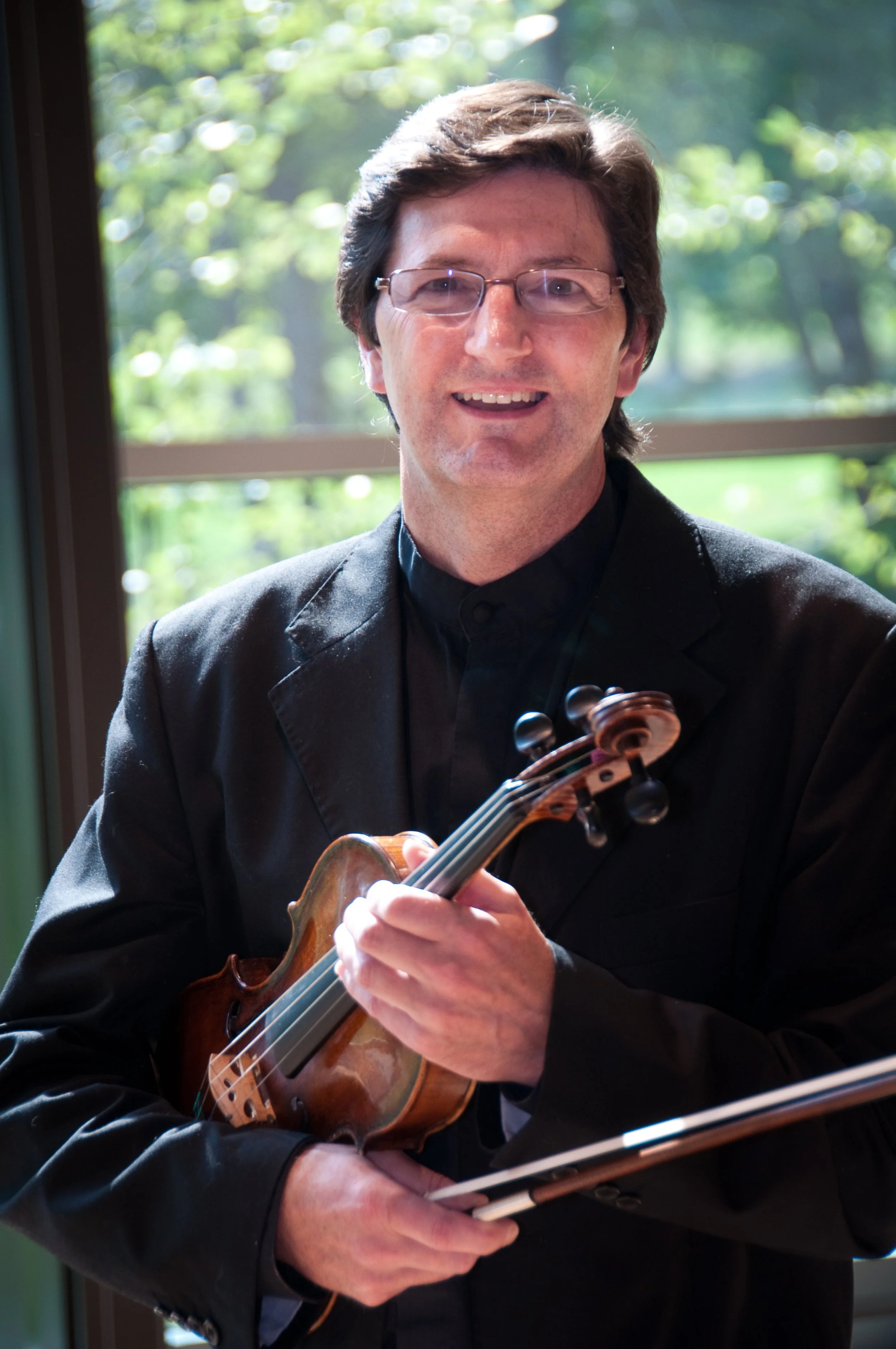
About violinist Michael Emery
As Distinguished Artist-in-Residence at Skidmore College, Michael Emery directs the vibrant string program, working with talented students on solo, chamber music, and orchestral repertoire. Through the annual Skidmore String Festival, which he initiated in 2005, the Skidmore community has enjoyed residencies by several highly acclaimed quartets, including the Brentano, Manhattan, American, Ying, Talich, Mirò, Parker, Pacifica and Dover.
Mr. Emery blends performance with teaching to create an active musical career. He has collaborated in chamber music with many international artists, including Ruggiero Ricci, André-Michel Schub, and Emanuel Ax, and has performed in the Sibelius, Ludwig Spohr and Paganini International Violin Competitions. He is pleased to join his colleagues Jameson Platte, cellist, and Matthew Quayle, pianist, to form the Omega Trio, which has toured internationally with piano trio repertoire as well as the Beethoven Triple Concerto.
Mr. Emery has coached and performed in several international summer music festivals including the Spoleto Festival dei 2Mondi and InterHarmony Music Festivals in Italy, Luzerne Music Center and KentMusic in New York, and Mahler Conservatory in Vienna.
He is concertmaster and frequent soloist with orchestras in New York and California, and has performed as soloist and concertmaster in Asia, as well as several major European cities.
Mr. Emery has performed in collaboration with many contemporary composers, including Gunther Schuller, Jennifer Higdon, Joan Tower, Ezra Laderman, Lowell Liebermann, Tommie Haglund, Richard Danielpour, and John Corigliano.
Mr. Emery earned his MM in Performance from the Manhattan School of Music as a scholarship student with Erick Friedman and Raphael Bronstein and served as concertmaster of the Manhattan Symphony. At MSM he was selected to perform in masterclasses with Ruggiero Ricci and Henryk Szeryng, and as the violinist for the sonata class with Misha Elman’s longtime collaborative pianist, Joseph Seiger.
Program Notes
Gustav Mahler: Symphony No. 5 Adagiaetto
Gustav Mahler’s excruciatingly beautiful music is laden with the melancholy and presentiment of hopelessness that often infused late nineteenth-century Romanticism. His large-scale symphonic works often require large numbers of performers (in great variety), and can challenge the endurance of the audience, as well as that of the players. More recognized in his time as conductor than as composer, he assiduously composed in summers, while pursuing a strenuous conducting career that was brought to an early end by heart disease. He was married in 1902 to the famous–some would say infamous–and beautiful Alma Schindler, a woman almost twenty years his junior. They had two winsome daughters, one of whom, Maria (“Putzi”) died tragically at the age of four in 1907. It is said that Alma bitterly blamed him for tempting fate by writing his Songs on the Deaths of Children. Constant bickering with singers and the virulently anti-Semitic press in Vienna led Mahler to New York City in the same year, where he became a star conductor with the Metropolitan Opera. His success there led him to an appointment with the New York Philharmonic in 1909 as principal conductor–a rival of Toscanini. Life was fulfilling, for he enjoyed working with the professionalism of the players there; but that year was marked not only by great success with the première of his Eighth Symphony, but by grief at the discovery of Alma’s affair with the famous young architect, Walter Gropius of Bauhaus renown. Mahler was heartbroken, and even consulted Sigmund Freud. After one more season in New York Mahler’s ill health forced his return to Europe, where he died of bacterial endocarditis in May of 1911.
Against this backdrop of personal stress and grief, Mahler seems today to be the perfect creator of intense, existentialist reflections on the dual nature of human existence, banal, yet transcendent. His personal–and to my mind it is uniquely so–rumination on life’s meaning can be somewhat prolix and repetitive at the symphonic level, or penetratingly aphoristic in his songs.
What is perhaps Mahler’s most well known music is the famous “Adagietto.” It is an added (standing in fourth place) movement in his expansive, fifth symphony, and gained worldwide fame for its ubiquitous use in the film, Death in Venice (1971), and in innumerable other places. Simply put, it’s an intense love offering to Alma, written in the summer of 1902, right after their marriage. He worshiped her, and it shows eloquently here, almost painfully so–especially considering the checkered relationship that plagued them almost from beginning to end. He met her while she was having an affair with her music composition teacher, Alexander Zemlinsky, and he died while she was in the notorious, semi-public affair with Gropius. Mahler’s letters to her, his anguished notations in his musical scores—they’re almost embarrassing—are a testimony to his long-suffering devotion to her. But, in the moment there was happiness, even if he exaggerated it in his mind. Not only newlywed bliss, but also incredible beauty—all in the music. After his death she blithely went on to collect serially other geniuses as her lovers. If the purity of the love he expressed was only in his mind, well, irony was Mahler’s middle name. © 2015 William E. Runyan
Felix Mendelssohn: Sinfonia No. 10 in B Minor
Although Mendelssohn's music figures into this program only briefly (if precociously, as we will see), his spirit pervades it. Felix Mendelssohn was born in Hamburg in 1809; the eldest male child in a prosperous family. His father was a banker and his grandfather a highly regarded scholar and philosopher. His mother, musically and artistically sophisticated, introduced the children of this multi-lingual family to the piano. When Felix's musical gifts were recognized, his tuition was taken over by the eminent composer and teacher Carl Zelter.
Even considering these fertile beginnings, it is unnerving to assess the young Mendelssohn's achievements; he was the ultimate prodigy. The quality of his output before leaving his teens shows a greater sophistication than that of Mozart at a comparable age. Some of the pieces we most immediately associate with Mendelssohn's name came from this period: the Octet for Strings from his 16th year, the overture to A Midsummer Night's Dream from his 17th. And both of these more than five years after his first public piano recital.
Mendelssohn's early instruction from Zelter inspired a reverence for his musical predecessors. His recent models were Mozart and Haydn (who died in the year of Felix's birth), but his studies were equally devoted to the "unfashionable" music of a still more remote era. In 1829, the 20-year-old Mendelssohn lead a performance of Bach's St. Matthew Passion in Berlin, the first significant presentation of the work in nearly 40 years and the beginning of a wide revival of interest in the senior Bach's music. The music of Bach's sons had eclipsed the popularity of their father's in the intervening generations.
Mendelssohn would first meet Robert Schumann in 1835; they were to be life-long colleagues and friends. Within a few years, Schumann, writing in letters, would describe Mendelssohn as "a god among men" and would go on to say:
"Mendelssohn I consider to be the first musician of the day; I doff my hat to him as my superior. He plays with everything, especially with the grouping of instruments in the orchestra, but with such ease, delicacy, and art, with such mastery throughout.”
After Schumann discovered a lost symphony among the papers of the deceased Franz Schubert, it was Mendelssohn who edited a working score and conducted in 1839 the premiere performance of what we now know to be Schubert's Ninth Symphony, the "Great" C major. Mendelssohn's career as performing musician, composer, and teacher, was the influential bridge, the passage between the great ages of the Baroque and the Classical periods into the Romantic era.
The work on this program, Mendelssohn's String Symphony No. 10 in B minor, precedes the years of the composer's greatest fame. It was completed in May of 1823 by a boy of 14. Only one movement has survived, and it is uncertain whether the symphony was conceived as a single- or a multi-movement work. Felix was studying with Zelter during its composition and the teacher's conservative musical leanings are reflected in the choice of form and style; the string symphonies of Carl Phillipp Emanuel Bach (1714-1788), second eldest son of Johann Sebastian, clearly were an inspiration, and the slow introduction is reminiscent of Haydn. The dramatic dash that follows, however, is pure Mendelssohn.
Ralph Vaughan Williams: Fantasia on a Theme of Thomas Tallis
Ralph Vaughan Williams (incidentally, pronounced: “Rayf, not Ralf”) is perhaps Britain’s most important and influential composer of the first half of the twentieth century. Prolific in most musical genres, he was an active composer from his student days right up until his death in 1958, at the age of eighty-six. He composed dozens of works that are part of the core repertory of British music of the last century, including the important series of nine symphonies. He lived a long life—long enough to have written in a number of rather different styles, all of them authentic and reflective of his changing interests and the times. He was born into an educated, upper middle class family, attended Cambridge University, and studied with eminent musicians and scholars, including a stint with Maurice Ravel. Among his early close friends and fellow students were such luminaries as Bertram Russell, Leopold Stokowski, and, of course, Gustav Holst.
In addition to his early activities as a rising composer, he and Holst were among the leaders in the efflorescence of serious study and collection of English folksong that arose in the late nineteenth century. He and Holst frequently spent time in the countryside tracking the rapidly vanishing body of song, writing them down, and preserving them. He later served as president of the English Folk Dance and Song Society. And, inevitably, his appreciation of this great literature became a major influence on one facet of his musical style—evidenced by every American band student’s encounter with his English Folksong Suite.
Another important interest and activity of his early on was his editorship of the English Hymnal (1906), his interest in the great English composer, Henry Purcell, and of all of the music, in general, of the Renaissance in England. It is the latter that is the inspiration for one his early and most beloved compositions, the Fantasia on a Theme by Thomas Tallis.
Thomas Tallis, along with William Byrd, was the most important of English composers of the Tudor era. He served under English monarchs from Henry VIII to Elizabeth I, dying in 1585. If you were quick you would have seen his character on the television show, “The Tudors,” so he certainly was not obscure. And he was resourceful, for though he openly maintained his faith as a Roman Catholic, he served under various religious regimes. One of his important publications (with his partner, Byrd, he enjoyed a monopoly granted by Elizabeth I printing any kind of music) was his 1567 collection of polyphonic settings of Psalm tunes.
In 1910 Vaughan Williams chose the third one of these as the basis for his own composition. He was familiar with it, for he had included it in the 1906 English Hymnal. The tune’s original title is simply “Third Mode Melody,” which refers to it being in the Phrygian church mode. Not major, and not minor, it is a marvelously mysterious mode that can be heard by playing the scale from “e” to “e” on the white notes of the piano. Written for strings, alone, the composer divides the orchestra into three groups of varying sizes, thus providing some interesting textural changes. The main tune is heard several times, but like any good composer, Vaughan Williams take various elements of the melody and creates the “fantasy,” which of course was a typical musical procedure during the sixteen century. A winsome diversion takes place not too long after the beginning in the form of a viola solo, this theme appearing in the full orchestra towards the end. A dry description this is, doing little justice to a sonorous, timeless evocation of the genius of an earlier musical style that is rarely heard in the modern concert hall. Vaughan Williams simultaneously created a tribute to one of the high points in the English arts, along with a perfect reflection of his own twentieth-century musical aesthetic. ©2025 William E. Runyan
John Corigliano: Suite from The Red Violin
John Corigliano’s Suite from The Red Violin is a concert work for violin and orchestra adapted from his Oscar-winning 1998 film score. It follows the journey of a haunted, centuries-old instrument, utilizing a recurring chaconne—a Baroque ground-bass pattern—interwoven with a lyrical, melancholic theme representing the violin builder's wife, Anna. The suite blends virtuosic solo passages with atmospheric, often darkly romantic orchestral writing, capturing the film's episodic nature across different time periods. It features a mix of lyrical, intense melodies ("Anna’s Theme") and dramatic,, sometimes aggressive variations that showcase the soloist's technical range. The score for the film was composed in conjunction with the film to allow actors to mimic actual performance, with the thematic material serving as the "haunting" soul of the instrument. The music is frequently structured around a recurring chaconne, acting as a structural anchor that evolves through different moods, ranging from soulful to virtuosic and frenetic. The suite often highlights the soloist against the orchestra, echoing the violin's journey as a, cherished, yet cursed object.